
Electricity Plans for Big Battery Households
I bought an all electric house: three-phase, 17kW of solar and 32kWh battery thanks to the incentives of the Cheaper Home Batteries Program.
I’ve never owned a house, solar system or battery and have quickly joined the growing cohort of “I have an enormous solar and battery system and don’t know what to do with it”. I’ve been looking into which electricity plan is should get.
The “problem” with these large residential systems is that you don’t have enough household load to utilise the battery. On simple self-consumption modes - charge from excess solar, discharge to offset house load - you find that large batteries tend to operate in the top 30-40% of their capacity, leaving tens of kWh idle.
To fix that you need regular opportunities to discharge the excess to the grid at a reasonable price. Until recently, the main way to do that was Amber Electric's wholesale spot passthrough. Now there are retail offers paying strong, predictable feed-in tariffs in the early evening:
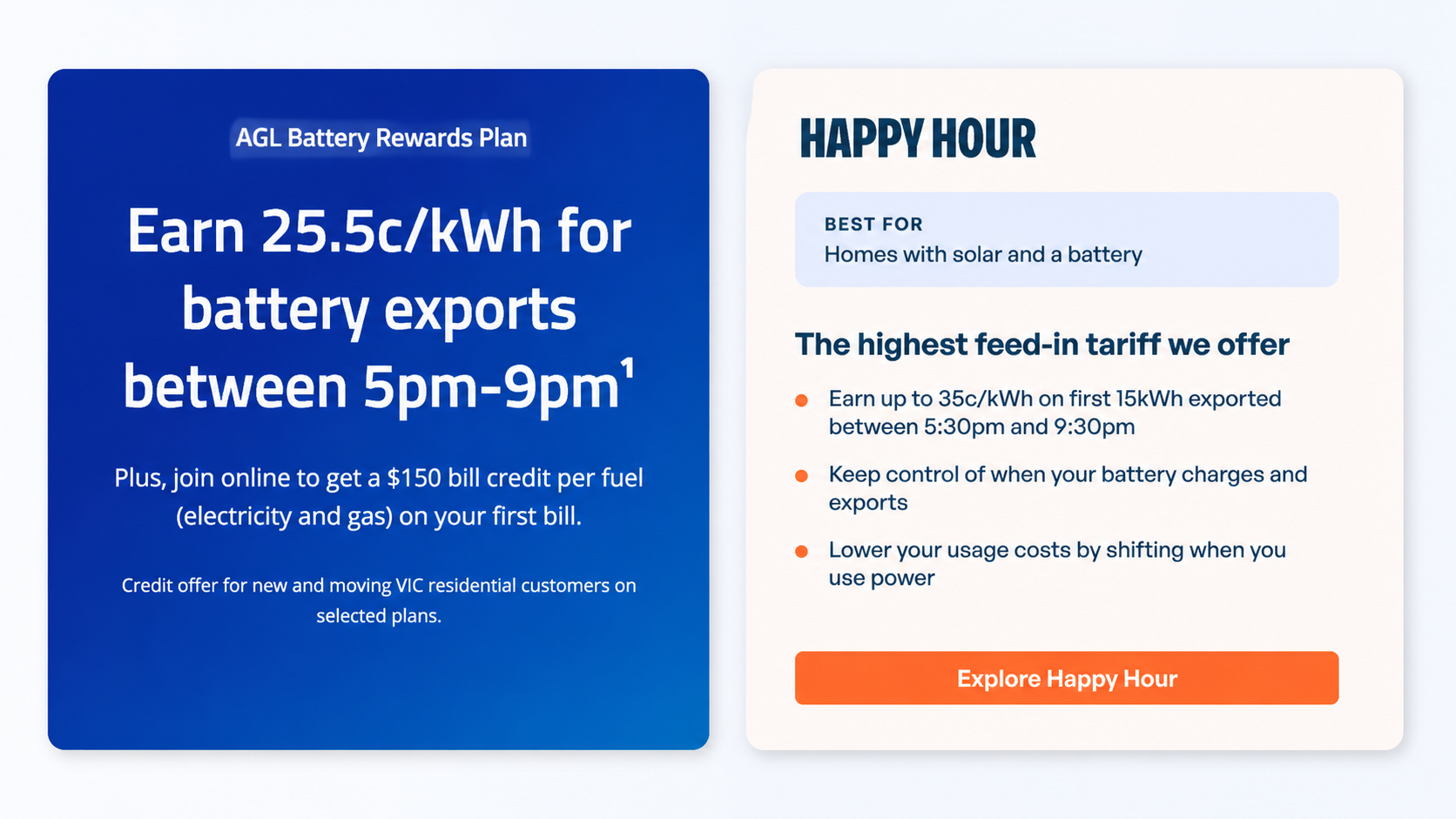
AGL’s battery rewards plan and Flow Power’s Happy Hour offer excellent evening feed-in-tariffs
These look great at first glance, but the relative value against a conventional plan is hard to read off the rate card. They carry higher daily charges or import rates, so you can end up worse off if you aren't exporting enough during the window. Will there be enough solar to fill the battery in winter? And how does any of it compare to Amber?
To answer this I did some Gridcog modelling, a tool I generally use in my day job to model much larger battery systems.
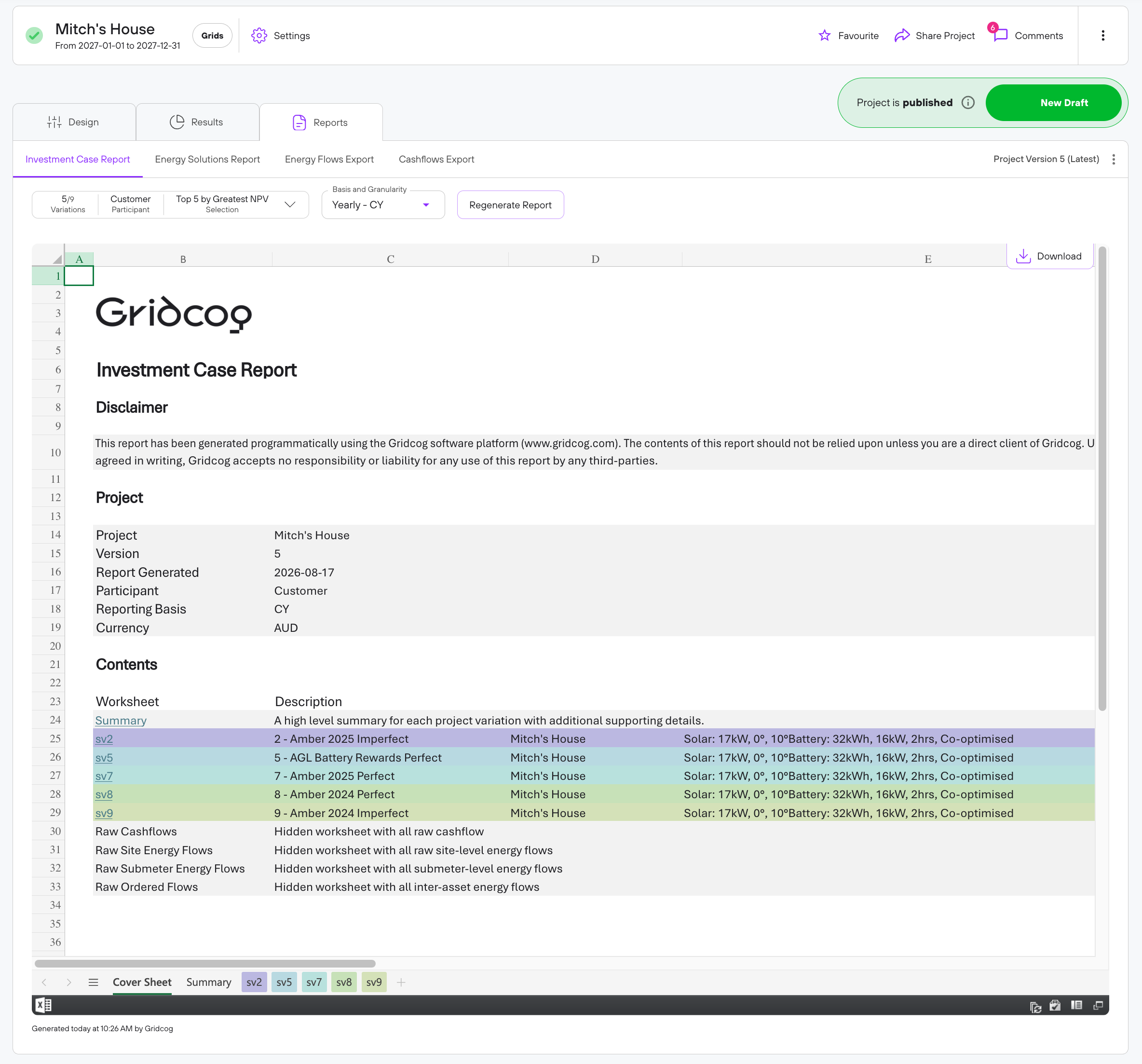
The whole model took about 20 minutes to set up
The Plans
In the model I compared four plans:
The Victorian DMO offer
Supply: $1.27/day
Import: 27.47c/kWh import
Export: 0c/kWh
Amber Electric
Network tariff: The Jemena A100 Single Rate
Wholesale: VIC spot prices in 2024/25
Additional charges: $25/month to cover fees, metering charges, etc.
Flow Power Happy Hour
Supply: $1.69/day
Import: 33.2c/kWh
Export: 30c/kWh for the first 15kWh between 5:30-9:30pm, 10c/kWh after that, 0c all other times
AGL Battery Rewards
Supply: $1.14
Import: 24.7c/kWh
Export: 25.5c/kWh between 5-9pm, 0.5c/kWh all other times
House
Usage: 18kWh/day, 8kW peak demand
Solar: 17kW DC, north facing, 10° tilt
Battery, 32kWh, 2 hour battery, 90% round-tripand DC-coupled
Connection: 15kW export limit (5kw per phase)
I ran each plan twice: once with perfect foresight, and once with simulated forecast error. Imperfect price forecasts for Amber, imperfect solar and load forecasts for Flow and AGL, to test the sensitivity of forecasting errors to financial outcomes.
To put a plug in for GridCog: it makes this very easy to set up. From supplying a library of household loads, geographically specific solar data and energy asset configuration, to supporting the variety of different tariff structures and forecasting errors I needed, the whole set up took about 20-minutes. Even the Jemena tariffs and historical wholesale data were sitting there ready to go.
The AGL Battery Rewards has a lower peak FiT rate than Flow, what it has going for it is:
Half an hour earlier, meaning I can get more pure solar exports in the peak window, particularly during the summer.
Lower supply/import costs.
Seemingly no limit on what’s exported a the peak rate.
On that last point, I had a look around AGL’s website and found only the most minor of limitations, of which only the NSW one would ever be binding:

The Results
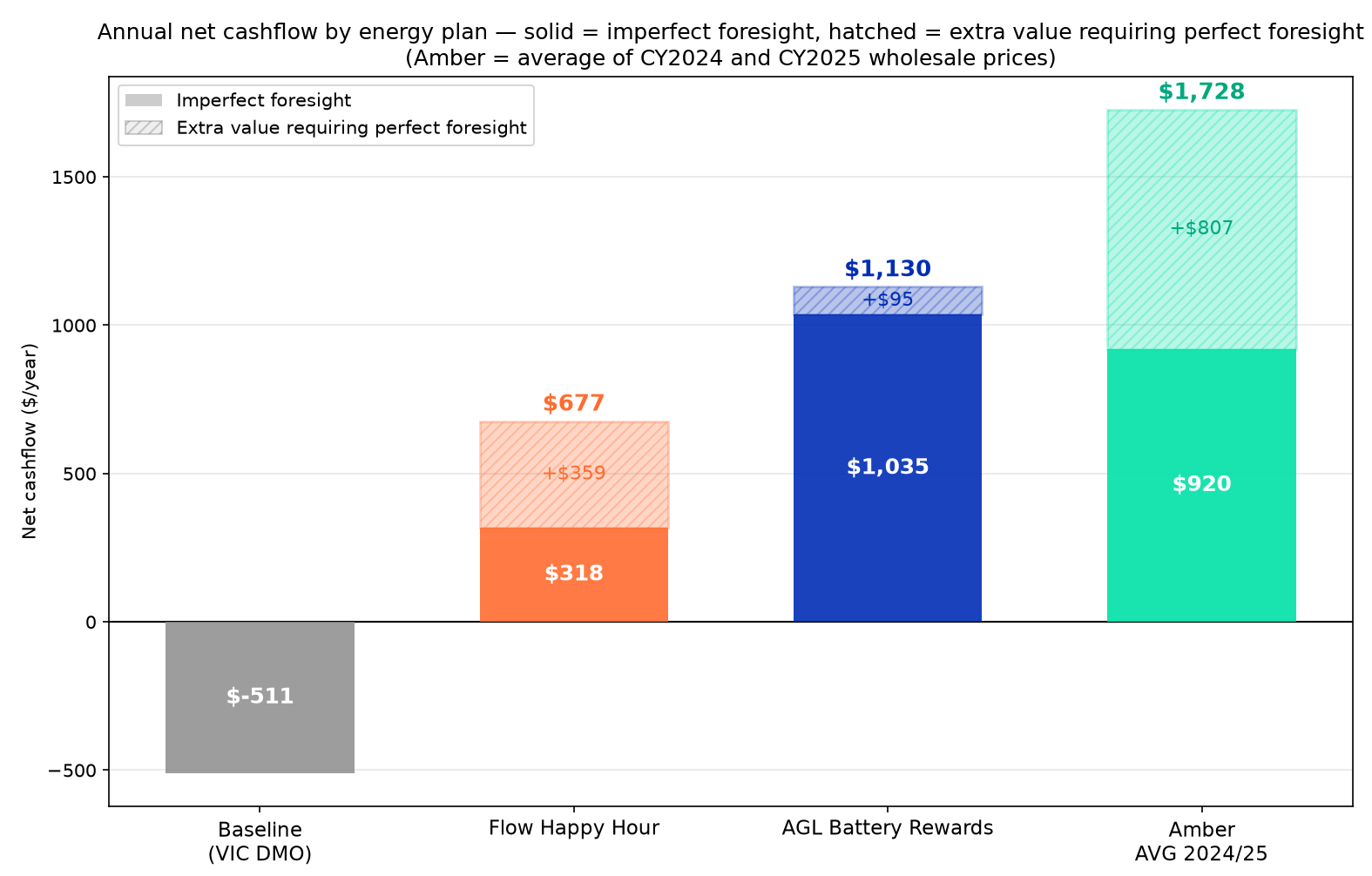
Annual net cashflow by plan. Solid bars are imperfect solar, load or price forecasts; hatched is the extra value available with perfect foresight. The Amber return is averaged over the 2024-2025 period. Amber imperfect foresight is using DEMA averaging and doesn’t necessarily reflect real world results.
Amber and AGL are quite similar on imperfect scenarios with Amber having more potential upside if the price forecasts are accurate.
Due to the similarity between AGL’s import and peak export rates (24.7c and 25.5c respectively) it’s very forgiving or forecasting errors. On the other hands Flow and Amber require accurate forecasting in different ways:
With Flow you’re trying to export only the amount of battery capacity you don’t need overnight. Export too much and you’re going to be importing at 33c in the early morning, export too little and your battery won’t discharge to empty before the sun rises.
With Amber you’re reliant on accurate wholesale prices in addition to load and solar forecasts. Miss a price spike due to insufficient battery capacity or consistently miss smaller opportunities and it really adds up.
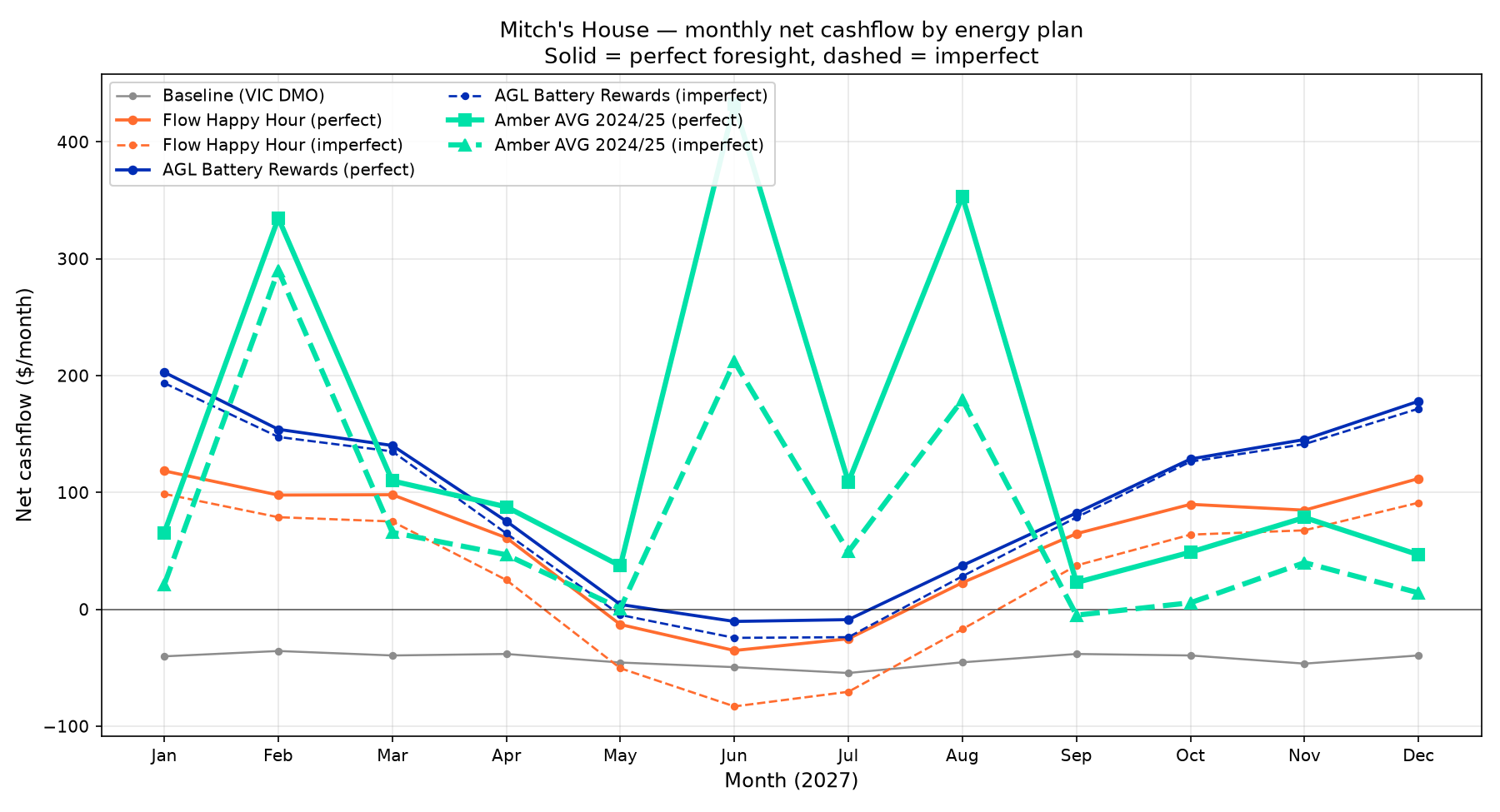
Monthly net cashflow. Solid lines are perfect foresight, dashed are imperfect.
The monthly view shows a few things:
The AGL and Flow plans are consistently good in summer, whereas Amber excels during volatile wholesale market periods.
The returns of AGL and Flow plans (with perfect foresight) are quite similar in winter then diverge in summer.
This last points is almost entirely driven by AGL’s uncapped peak exports and additional solar exports sneaking into that 5-9pm period in the summer months.
AGL’s half an hour earlier start time (5pm vs 5:30 on Flow) really helps too, with 36% of the solar export value occurring in the 5-5:30pm period, adding an extra $116 in savings on the annual bill.
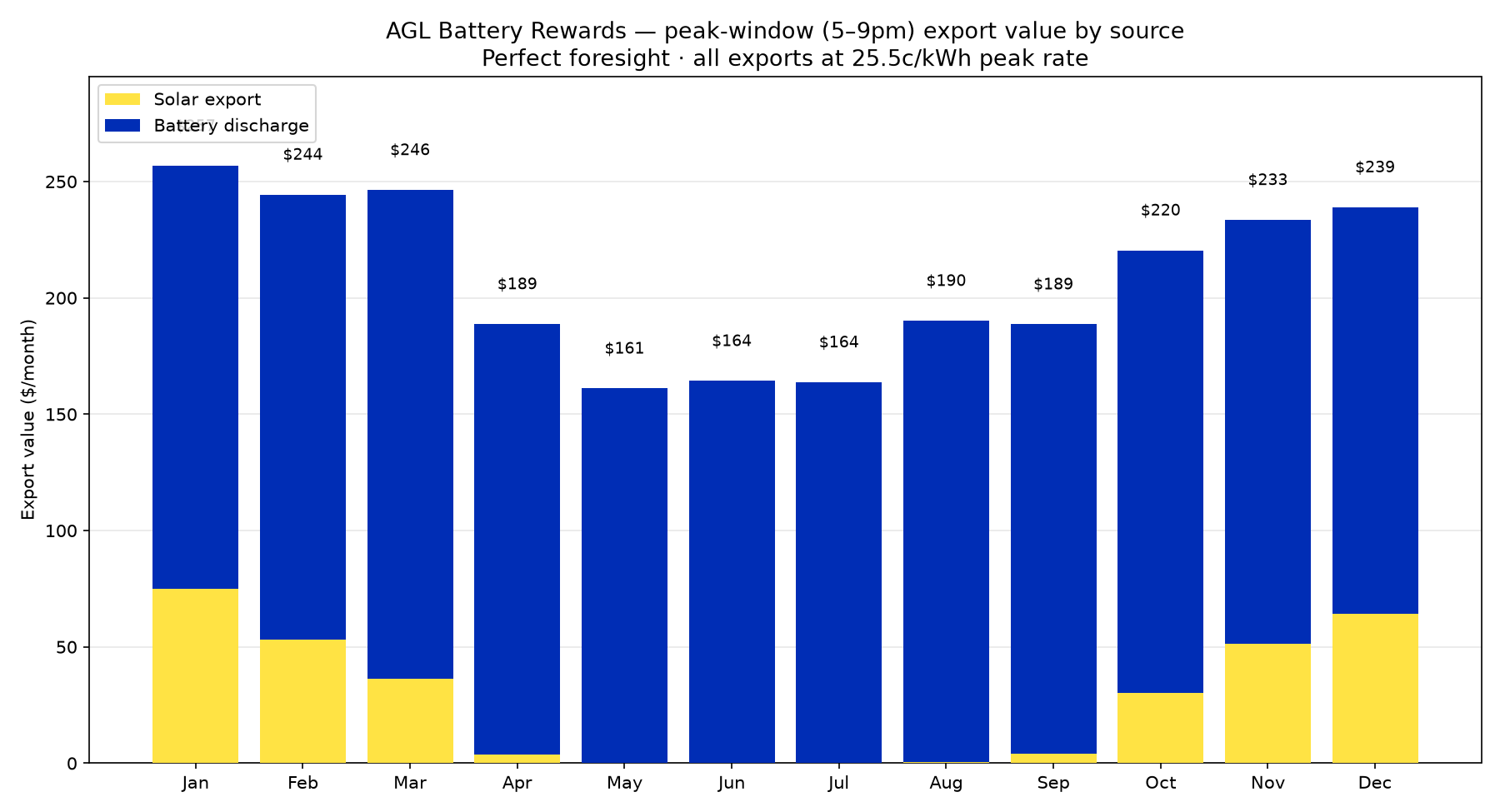
Where the peak-window export value comes from under AGL: solar exports vs battery discharge
Takeaways
For my specific situation:
The AGL is a great plan. Perhaps too great and I wouldn’t be surprised if the deal is weakened over time. For now I’ll be making the most of it.
I looked forward to writing a load forecaster and control system to make the most of the Flow Power plan, but turns out I’ll just need a simple algorithm on AGL to fully discharge the battery between 5-9pm.
Amber looks great during high wholesale volatility. With VIC $300 caps sitting at $13.75/MW in Q127 I’ll probably move over for the summer, and I’ll be watching closely for coal closures over the next few years.
There’s some broader implications too:
These peak export plans differ from VPPs as the retailer doesn’t control your battery. Instead they set a price and it’s up to you to program or control your battery to achieve your goals. The home owner relies on the quality of the in built battery control system, and some plans like Flow require quite sophisticated forecasting and control to maximise savings. On the one hand this gives control back to the customer and may solve many of the trust and transparency issues of some VPP plans, on the other it now makes battery operations their (and their OEM’s) problem.
It’s quite hard to compare plans at face value to get a good understanding of what’s best for different people. Customers would benefits enormously from tailored modelling and advice, and this would likely require an uplift in the modelling capability of sites like EnergyCompare and what battery installers and 3rd parties tend to offer.
Overall these new types of plans are a terrific development, and it's good to see the market building products for oversized battery owners like me.
I do energy modelling with tools like Gridcog for projects of all sizes, from gigawatt-hour hybrids under complex offtake agreements to C&I and microgrid set-ups. Get in touch (details at the bottom of this page) if you'd like to talk about your project.
The graphics in this post were produced by Qwen3.8-27B running locally. It's quite good.
